

Why Your School Had a Bell
Obedience Training for the Age of Managed Time

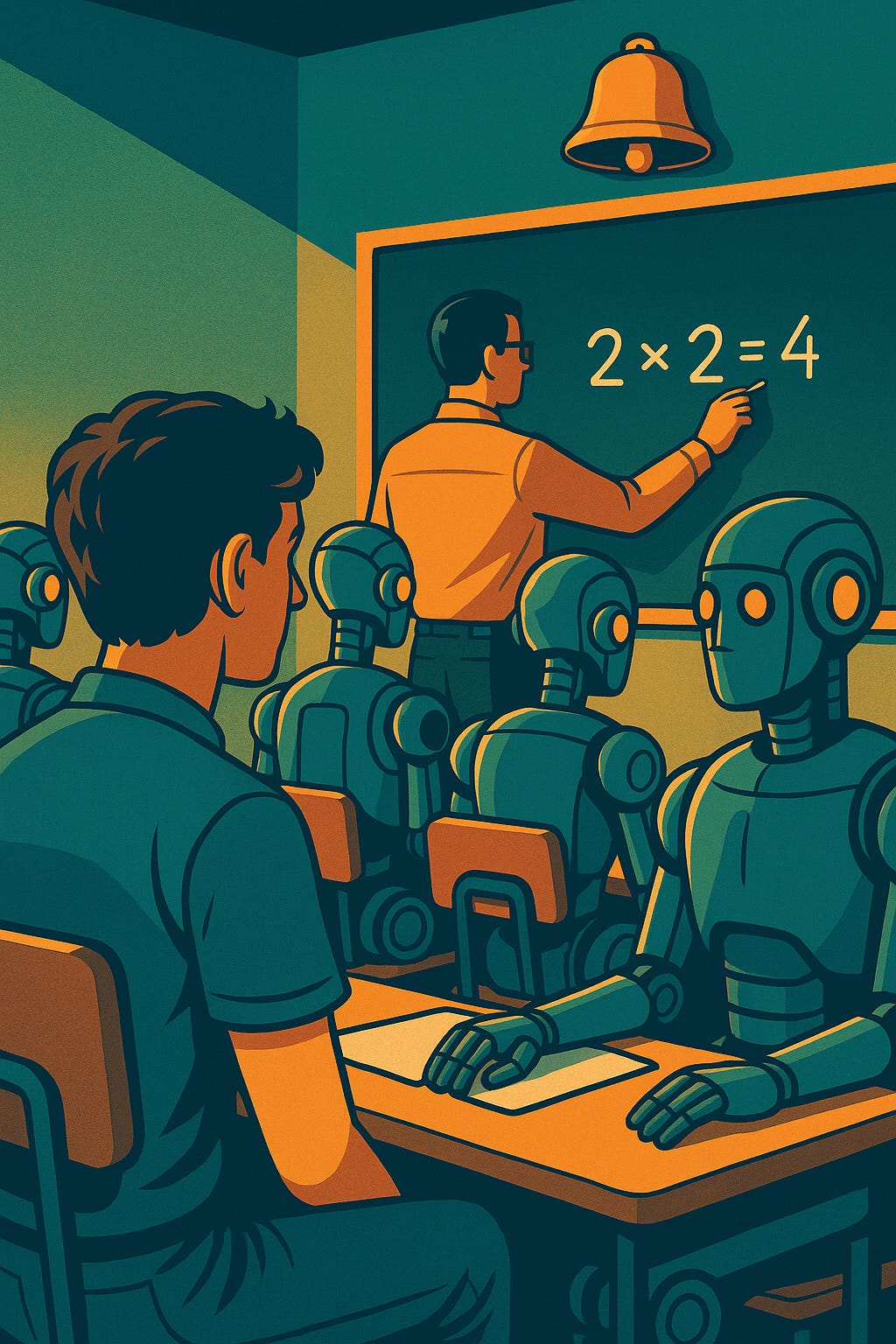
The Bell Was Not Really for You
Every child grows up hearing it: the metallic ring, the abrupt buzz, the unmistakable signal that dictates what comes next. Sit. Stand. Change rooms. Line up. Wait. The school bell offers no explanation. It simply overrides whatever you are doing and declares that it is time to stop, not because the lesson is complete, but because the schedule demands it.
The bell’s purpose was not primarily to deepen learning. It was to manage bodies. It enforced transitions, not comprehension. Over time, it became the first behavioral fence.
Time Was the First Lesson
The rise of industrial society brought a new kind of worker, the one who obeyed clocks, endured boredom, arrived on time, took breaks on cue, and stopped working when told.
Bells in schools were introduced before full-scale industrialization, often for logistical reasons. But the cultural shift toward time obedience aligned with this mechanical signal. When a bell tells you when to think, when to stop, and when to move, the tool becomes part of the training. Even if its original function was practical, the effect was behavioral. You learn to follow the clock before you learn to question the material.
This System Was Designed, Not Discovered
In the early 1800s, Prussia developed a centralized, state-run education system with several goals: national cohesion, increased literacy, military readiness, and civil obedience. The system emphasized punctuality, repetition, and deference to authority. While reformers like Wilhelm von Humboldt also envisioned broader intellectual development, the dominant structure favored uniformity over individual exploration.
Horace Mann toured Prussia in 1843 and became a vocal supporter of its structured approach. In his 1844 Seventh Annual Report, he praised their emphasis on system and order. He did not copy the model wholesale, but he advocated its principles for democratic purposes, particularly equal access and moral discipline. Still, what emerged in Massachusetts reflected many of the same structural values: centralized control, externally set pacing, and enforced conformity.
The Factory Was Just the First Client
Critics often invoke the “factory model of education” to describe rigid, bell-driven schooling. While the comparison is historically imperfect, the metaphor persists for a reason. The time-discipline embedded in schools mirrored the needs of emerging bureaucracies, not just factories.
The bell-and-schedule structure was not designed solely to produce factory workers. It fit any role requiring compliance under supervision: clerical work, customer service, logistics, and compliance-heavy office environments. School was never just about preparing children for a specific job. It was about preparing them for a world governed by external authority.
And in many ways, it still is.
What the Structure Actually Teaches
Some students thrive on routine. Some subjects demand repetition. But in most traditional settings, school does not reward curiosity. It rewards compliance.
You ask permission to speak. You raise your hand to use the bathroom. You shift tasks every 45 minutes, even if you are not ready. You memorize fragmented content, then forget it after the test. You are evaluated more on pace and obedience than on depth of understanding.
The outcome is not just shallow education. It is normalization. Students learn to expect interruption, deferral, and evaluation on someone else’s terms.
The Curriculum Beneath the Curriculum
The real lessons of school are not printed in textbooks. They are embedded in the mechanics of the day.
Show up on time. Sit where assigned. Do not ask too many questions. Defer to authority, even when it contradicts itself. Do not finish early. Do not fall behind. Do not argue when the bell rings. Complete tasks on a schedule. Equate following instructions with doing well.
This is the hidden curriculum. It does not teach students how to learn. It teaches them how to behave in systems that value compliance over insight.
Why the Model Still Holds
The industrial economy has shifted, but the structure of school remains. Why?
Because time-based schooling still works for those who oversee it. It scales easily. It standardizes outcomes. It simplifies measurement. Testing companies, state agencies, and curriculum contractors continue to center education around fixed pacing, periodic assessments, and predictable transitions.
Even though many teachers resist, the underlying system still prioritizes time obedience over deep learning. Not because it is the best way to educate, but because it is the easiest way to administer.
Resistance Exists but Rarely at Scale
Some parents choose to homeschool to avoid this structure. Montessori and Waldorf models intentionally bypass bells and rigid schedules. Some teachers allow students to keep reading past the buzzer. Some districts test longer block formats and open learning environments.
But these remain outliers. Most students spend thirteen years inside a system where the clock dictates motion and success is measured by timely completion. Over time, that rhythm feels normal. You work when told, wait for permission, and succeed by finishing on time.
That is the pattern. Resistance exists. But replication dominates.
How to Push Back For Real
You will not dismantle the system overnight. But you can interrupt its grip.
Ask your school board why learning stops when a bell rings. Request one weekly period for self-directed learning. Support teachers who break schedule for genuine curiosity. Let your child finish a thought instead of rushing for a hallway transition. Question whether time obedience deserves moral status.
You are not fighting school. You are fighting the uncritical belief that scheduling is virtue.
And every time a student keeps thinking past the bell, you take a little bit of that belief away.
Notes & References
Horace Mann’s 1844 Seventh Annual Report is available via Massachusetts archives.
Historical context of the Prussian model can be found in works by Thomas S. Popkewitz and James Bowen.
The 2018 Brown Center Report on American Education (Brookings Institution) covers standardized testing trends.
Montessori and Waldorf education models explicitly reject bell-timed transitions. See AMI/NAIS documentation for curriculum overviews.
Thank you for being here
If you found this essay useful, subscribe for more deep dives. Paid subscribers get full archive access and free PDFs of all my books. If you can’t afford it, email me and I’ll send you what you need.
I was raised in a military family. My father was a flag rank Air Force officer and I lived on base until the age of 14. One of his commandments was, “Always be on time.” Time is the most important commodity you will ever have and it deserves respect. Being late is disrespectful to those you are supposed to meet/work with. Waste your own time if you wish but, never anyone else’s. “Always be on time.” When I worked in film the saying was, “If you’re on time, you’re late.” For them being on time meant ready to work at the prescribed time. Those sets were time regulated as well. Felt like being in school all over again.